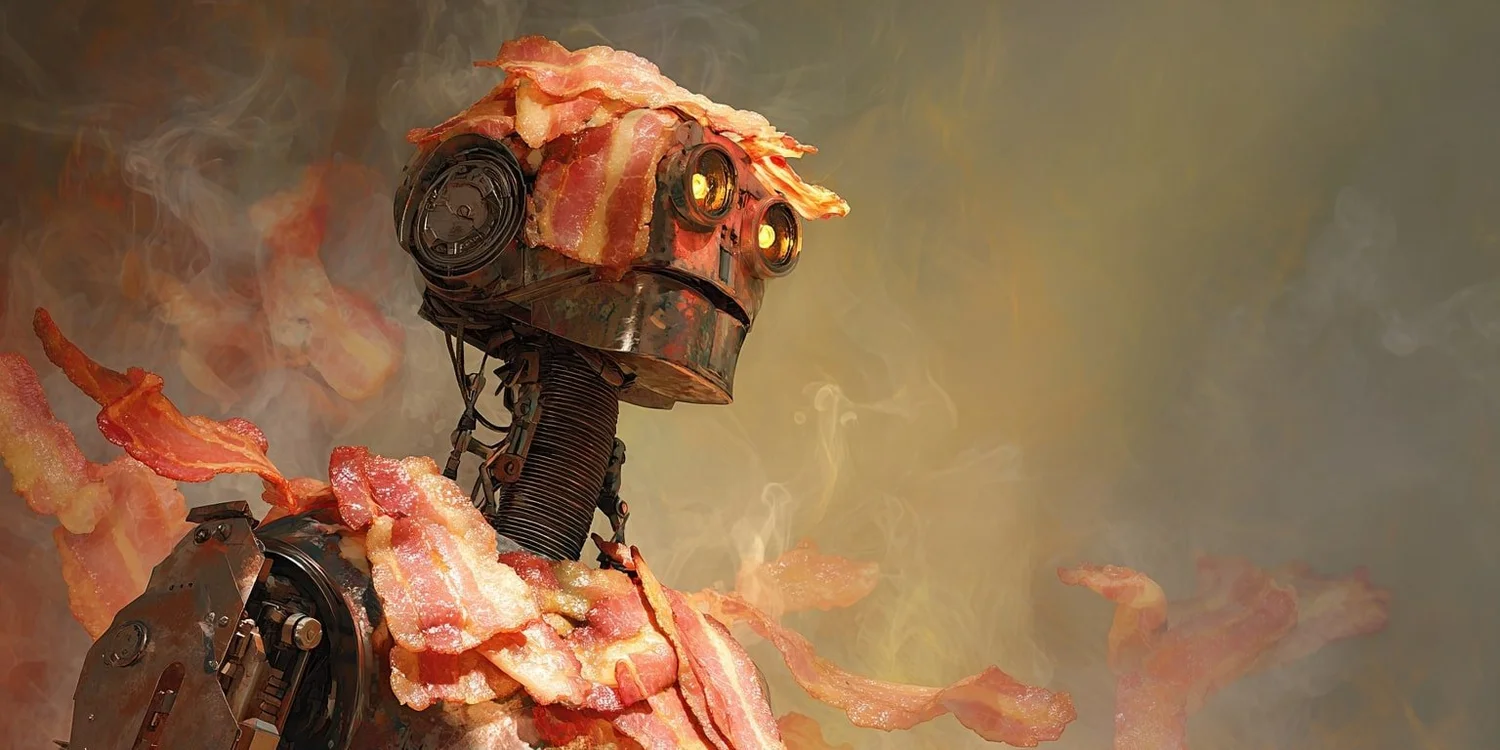
Is AI Better than Bacon?
Time to get philosophical, because why not? At the core of this cheeky question, “Is AI better than bacon?” lies a deeper inquiry: What do we value more, the power of the mind or the pleasures of the flesh (the delicious, smoked flesh of a pig in this case)? It’s a classic brain-vs-belly showdown, Socrates meets Epicurus, high logic meets hearty breakfast.
AI represents the pinnacle of human intellectual achievement … it’s all about the mind, reasoning, intelligence, the very things that historically were thought to separate humans from animals. Bacon, humble and beautiful, represents something very earthy and primal … the satisfaction of basic human appetite, a connection to our senses and survival instincts. So which one is more “important” to being human?
One could argue, in a whimsical way, that our ability to enjoy bacon is just as profoundly human as our ability to create AI. Think about it: an AI can beat a chess grandmaster, but it cannot enjoy a simple pleasure. The very experience of enjoyment, of savoring bacon’s taste, is uniquely tied to consciousness and biology. If one day an AI becomes truly sentient, how will we test its humanity? Forget the Turing test … maybe we give it a slice of bacon. If it goes “Mmm!” and does a happy dance, voila, it’s basically human! (And probably very confused about why it didn’t discover this bacon thing sooner).
There’s also the Maslow’s hierarchy of needs angle. Food is at the base of the pyramid … you need to satisfy hunger before you worry about self-actualization. Bacon neatly slots in there as a high-ranking officer of foods. AI, in contrast, is sort of a luxury at the top of the pyramid … it’s a product of a society that’s already met its basic needs and is looking to optimize and intellectualize. In a world where people are starving, AI isn’t a priority … food is. And if that food happens to be mouth-wateringly tasty, all the better. In a sense, bacon (as food and as pleasure) addresses a more fundamental human need than AI does. You can survive without AI; you literally cannot survive without food (and life would certainly be a bit drearier without tasty food).
Let’s also get absurdly metaphysical: Some philosophers and scientists have debated what the “meaning of life” is. Could it simply be the pursuit of happiness? If so, a case can be made that bacon contributes mightily to small, daily happiness in a way AI seldom does. A perfectly crispy piece of bacon can feel like a tiny, meaningful moment in your day. A little reminder that the world can be good and joyful. AI’s contributions to meaning are more abstract. It might help cure diseases in the future or solve grand problems, which is deeply meaningful on a societal scale. But on a personal, in-the-moment scale, a piece of bacon on Sunday morning might subjectively feel more “meaningful” to a person than an AI running in the background of their phone.
And what about free will and desire? Humans often worry that AI might one day outsmart us, maybe even develop desires of its own. If one of those desires turns out to be bacon, well, that’s a plot twist for the ages: Skynet goes live, gains consciousness, and its first act isn’t launching nukes but raiding all the grocery stores for bacon. (Honestly, we might be sort of okay with a benign AI overlord whose only demand is “give me all the bacon”. At least we’d understand its motivations perfectly.)
In the end, this philosophical rambling highlights that comparing AI and bacon is like comparing the mind and the body, the future and the present pleasure, the abstract and the tangible. It’s a fun exercise because it reminds us that no matter how advanced our technology gets, we’re still creatures who find immense joy in simple things, like crispy strips of bacon. Perhaps the true wisdom is balance: use AI to improve life, but always stop to smell (and eat) the bacon. As a wise person (me, just now) once said: “I think, therefore I ham.” In other words, our ability to both think and enjoy something like bacon is what makes us beautifully human.